
Alexander MacGregor, Baritone, 1883-1969
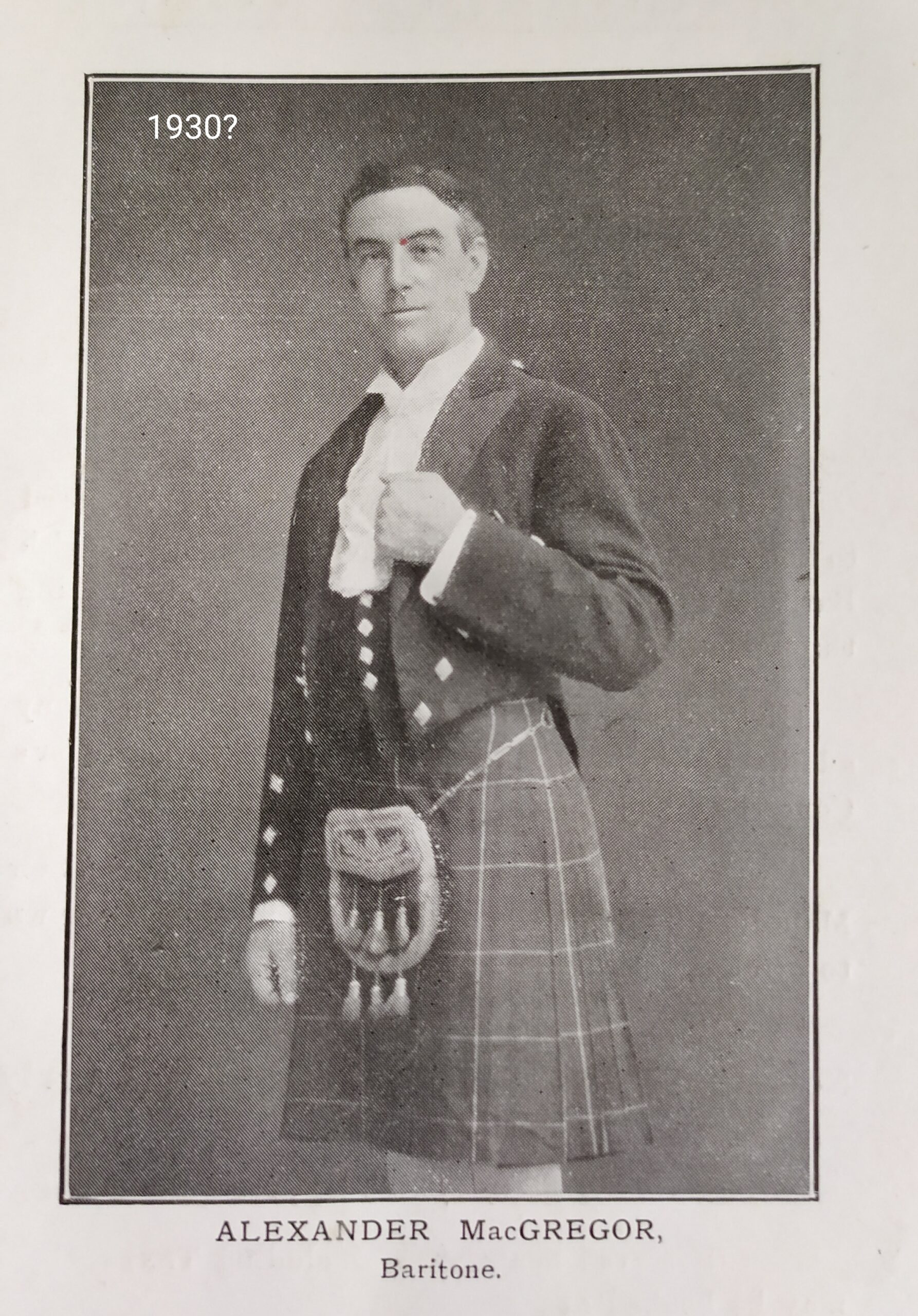
This page contains all the information about Alexander MacGregor, a famous baritone singer of traditional Scottish songs from 1912-1930s. It has been researched by his grandson, Revd Donald MacGregor, from his family records and from internet archives .
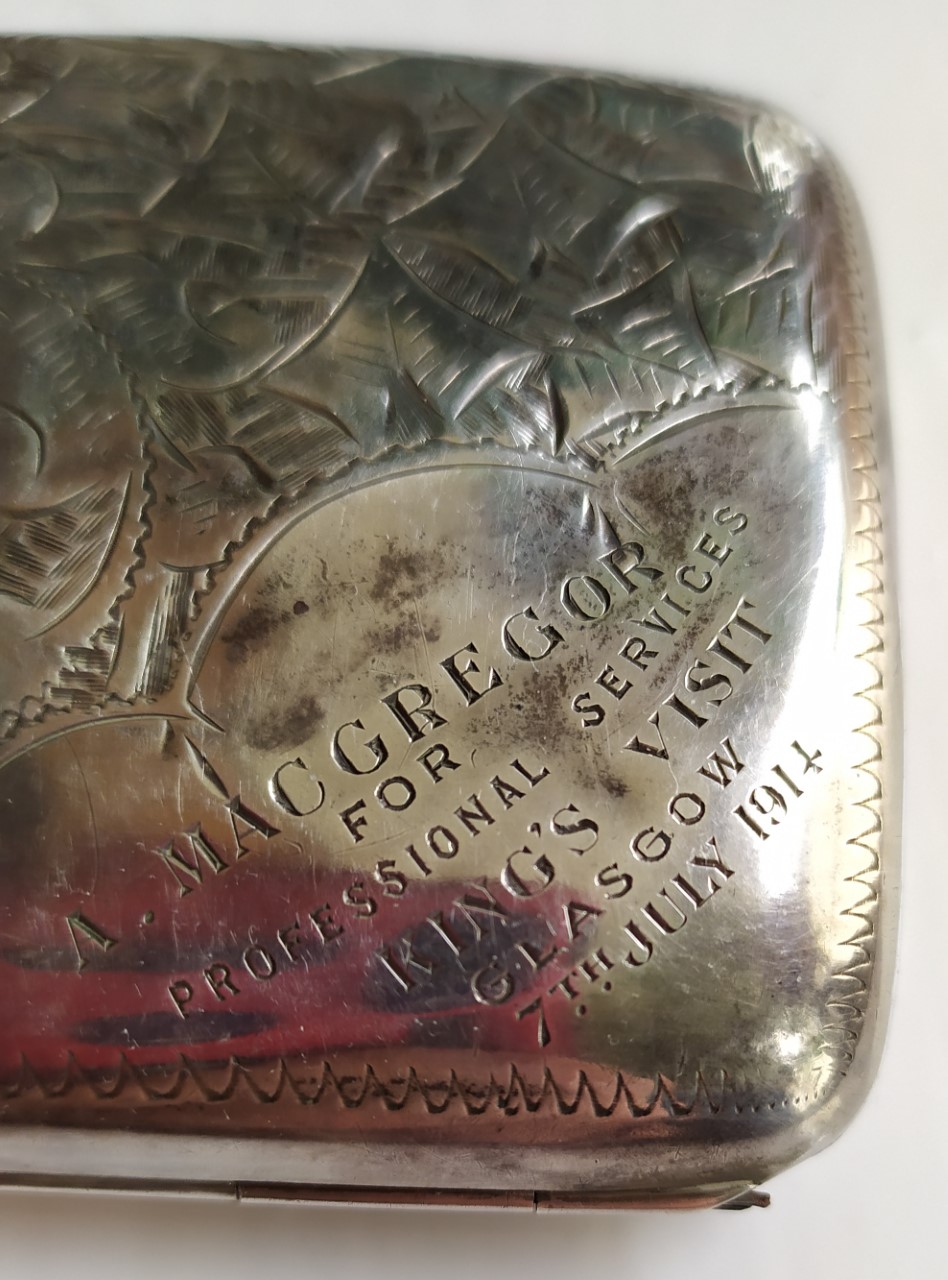
Alexander MacGregor (1883-1969) was a famous baritone singer in the early part of the 20th century, mostly in Scotland, but with forays into England and Ireland, and even a tour of the USA and Canada. When aged just 21 years, he sang before King George and Queen Mary on their visit to Glasgow on 7th July 1914 as part of a tour of Scotland’s industrial communities. This visit occurred just weeks before the outbreak of World War I. Several years later, on January 26, 1923, during the Scottish Clans Association Concert at the Albert Hall in London, he performed alongside artists like Phyllis Lett and Flora Woodman.
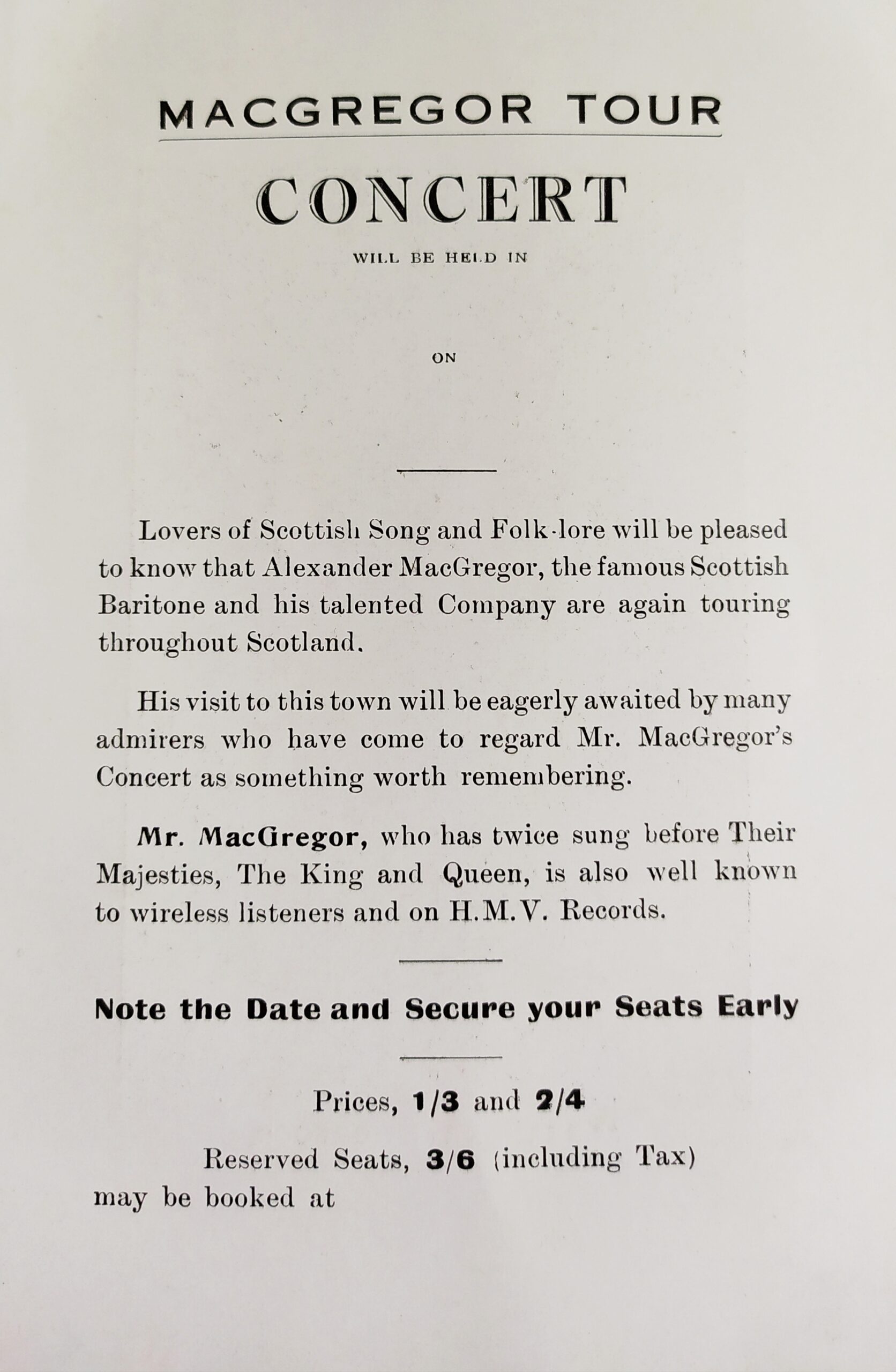
He was one of the earliest artists to broadcast via radio from a Glasgow studio and also to sing Scottish songs from Marconi House in London, even before the BBC was formed. He taught voice at the Athenium Theatre in Glasgow in the 1920s. He became famous – when my father went to Jordanhill College in Glasgow for an interview in the late 1930s, the head said to him “MacGregor? – You’re not related to Alexander MacGregor the singer are you?”
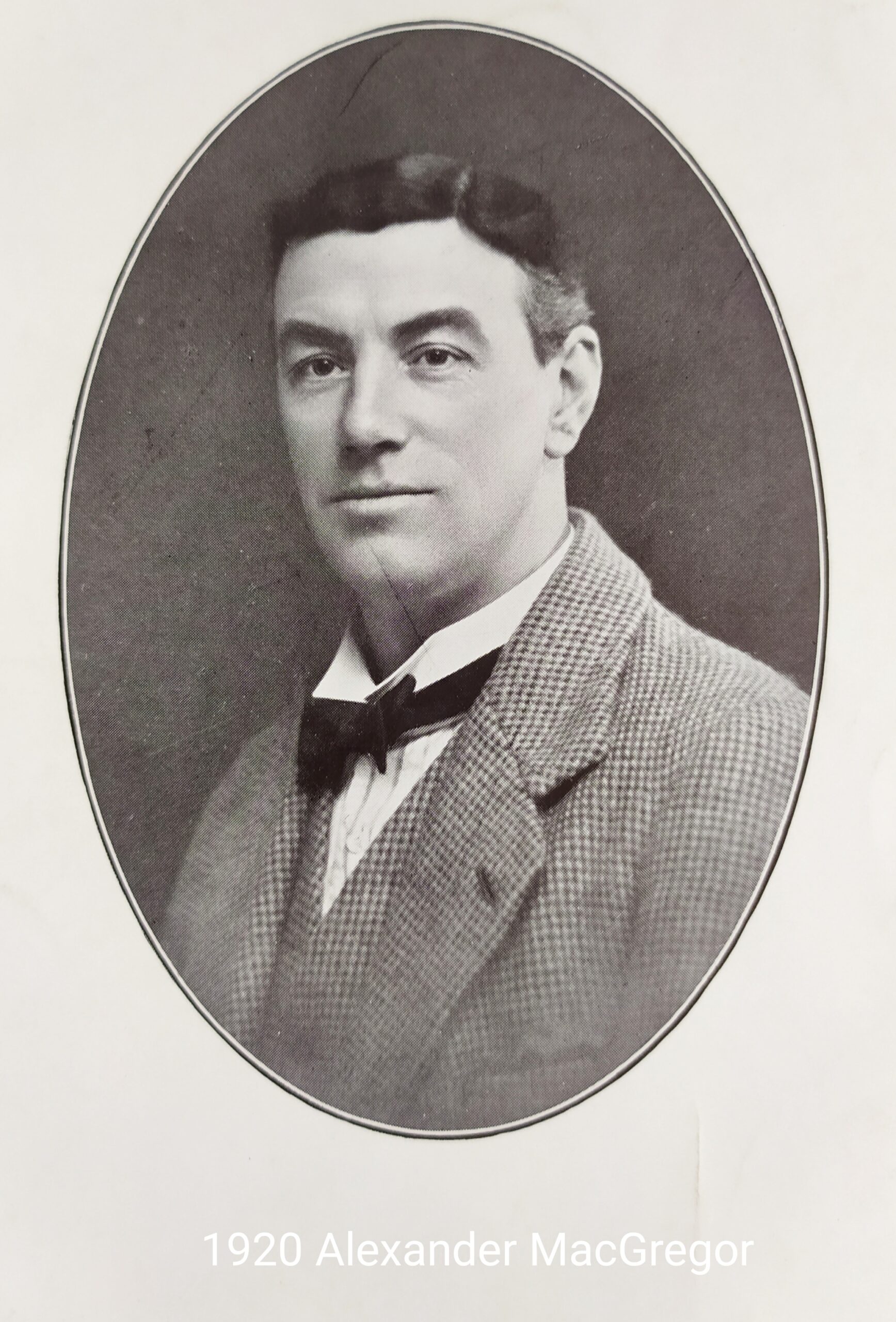
His first marriage was to Catherine MacCrimmon on 29 March 1907, who gave birth to a daughter, Marion, and three sons, Alexander, Donald (my father) and George, all separated by six years. Catherine died of a stroke around the time my parents were married in 1948. Alexander remarried to Bet – Elizabeth C. Balfour, nee Olding, who died 14th June 1976.

Granpa Alexander and Bet visited us several times in Birmingham when I was young. We moved to Leicester when I was six and I remember them visiting us there when I was about 9 or 10. My father made the comment that his old man, aged 80, could still take the stairs two at a time! But soon after that he had a stroke and was bedridden for several years. When we visited him in Glasgow he would be in bed with his ginger toupee on, and couldn’t speak, but my father would sing some of the old Scots songs to him and his face would light up. He tried to sing along, mumbling the words. Quite sad, really. He died in Glasgow on 17 August 1969, aged 86, when I was 15 years old.
Biographical Details
· Born 5.30am 22nd March 1883 at 92 Queen Street, Govan, Lanarkshire
· Died 13 August 1969 after being bedridden for several years from a stroke.
· His father was Joseph MacGregor, Ship Yard Watchman. His Mother was Eliza MacGregor, nee Knox. They were married 23 August 1866 in the parish of Keith, in Banffshire and moved south to Glasgow. There is family history that traces them back to this area since the mid 1700s. As this was during the time the MacGregor name was proscribed and MacGregors were hunted down and executed, it is assumed that the clansmen migrated from their homelands around Loch Katrine, becoming ‘children of the mist’ as they disappeared into the Cairngorm mountains and eventually settled near Keith, at Broadrashes farm.
· During the First World War, Alexander worked as a shipwright in the Govan docks, a protected profession, and carried on his singing engagements. By the time my father was born (1919), he was turning professional.
· 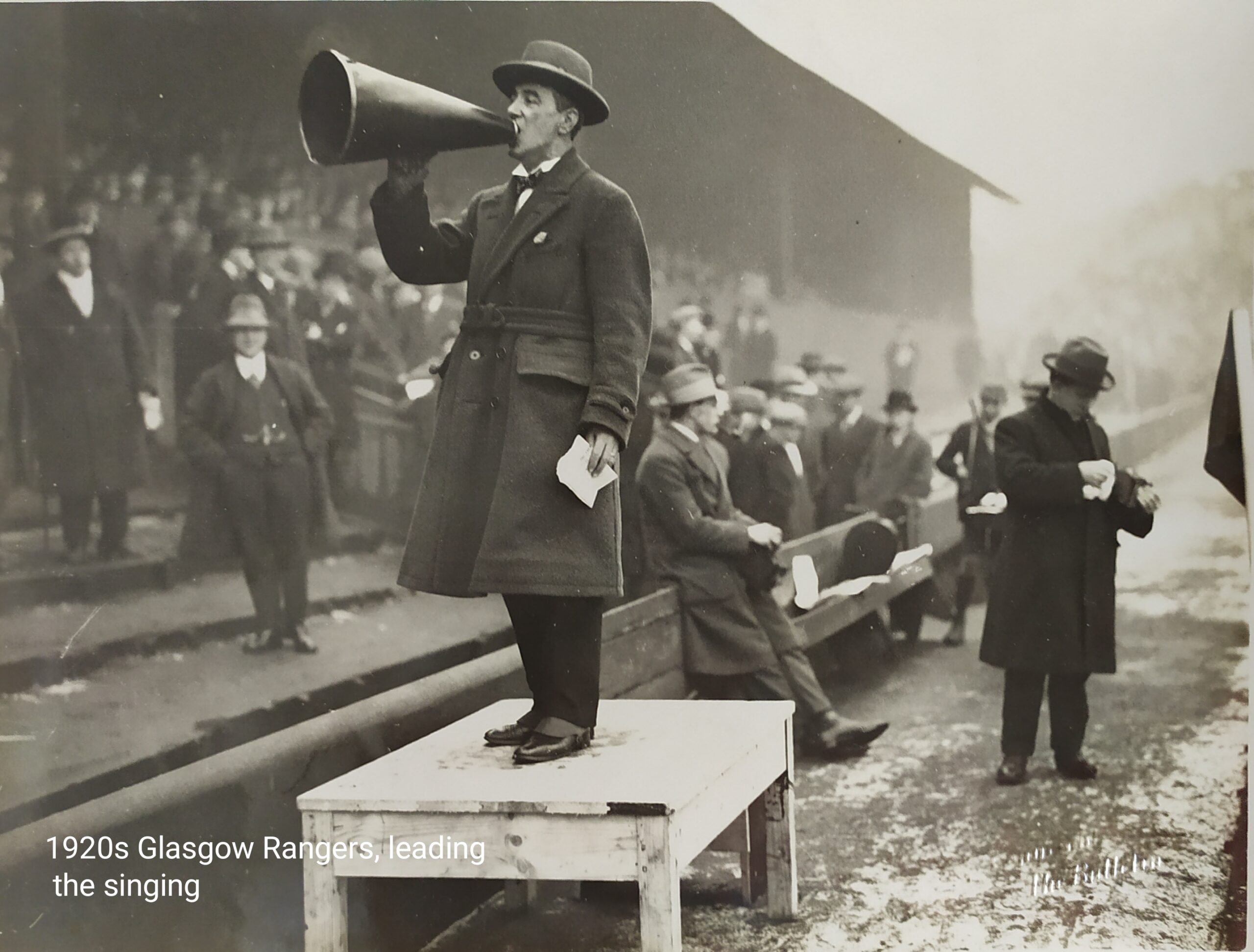
He often led the singing at the Glasgow Rangers football matches, standing on a platform and using a megaphone.
The earliest records of his performances are in a newspaper cuttings book, kept by either his mother or his wife, and in my possession. It includes newspaper cuttings from 1911-1932, and gives an idea of the range of places he sang in. From Oban and Iona in the north, to Galloway in the south, he performed regularly all over Scotland from 1911 to the 1930s, sometimes accompanied by his daughter Marion on piano. As his fame spread, he ventured into northern England, Scarborough and Warrington and to Belfast, then to London in the early 1920s, where he was selected to sing over the newly developed wireless radio.
Performance History
The Radio Times, which gave the programme schedule for the British Broadcasting Corporation (BBC) can be searched and over 120 entries for Alexander MacGregor are shown between 1923 and 1927 at:
Radio Times
Conductor, JOHN A. McIVOR, ALEXANDER MACGREGOR(baritone)
Alexander MacGregor began to study music at the age of seven, and at sixteen was conducting a junior operatic choir. He continued his studies in theory and took up singing. He joined the then famous Glasgow Select Choir, and completed a tour with it of 12,000 miles in the United States of America and Canada. On his return to Glasgow he commenced his career as a professional singer. He was one of the earliest artists to broadcast from a Glasgow studio and also to sing Scottish songs from Marconi House. He has sung in oratorio for all the principal choral organisations in Scotland, including the Glasgow Choral Union.
Here is a brief selection of the newspaper clippings that are in a very yellowed scrapbook in my possession.
· 1911 Sept? Glasgow Ross and Cromarty Association. “Songs and recitations were performed by… Mr Alexander Macgregor (a young highland professional singer of great promise)… “
· 1911 25 December Glasgow News. “Abstainers Union Recital”. A specially attractive programme was chosen for the Christmastide concert of the Abstainers’ Union in the City Hall on Saturday evening. The recital was provided by the Glasgow Select Choir under the expert conductorship of Mr George McTaggart… Mr Alex. McGregor sang with fitting gusto Sullivan’s “Ho Jolly Jenkins”.
·
1912 Govan Press: “Success of a Govan Singer” – Mr Alexander McGregor, who gained the judges medal at the Govan Corporation concerts, succeeded in winning one of the two gold medals given by the Rosebery Burns Club, to the best singers of Scots songs, at their concert last Friday night held in the Christian Institute, Glasgow. The Lord Provost, in presenting the medal to Mr McGregor, said his rendering of that fine song by Burns, “To Mary in Heaven” was the finest he had ever listened to. … Mr McGregor also received intimation this week from the Tonic Sol-Fa College London, that he has successfully passed the examination for the third grade staff notation certificate. Mr McGregor has received all his musical training from Mr Jas. Moncrieff, A.C., the genial conductor of psalmody in St Columba U.C. Church, Govan, under whose tuition he has taken the following certificates at the Tonic Sol-fa College – Elementary and Intermediate, with theory honours, matriculation, first second, third grade staff notation certificates, musical and verbal expression, and harmony analysis, and is at present studying musical composition, with w view to taking the highest certificate of the Tonic Sol-fa College.
1912
· 1st January. Hamilton Advertiser. Concert In Abington. “The baritone numbers call for special mention. In the rendering of ‘Marches of Morven’ Mr Alexander Macgregor’s full and resonant voice was heard to much advantage.
· Cupar: “Choral Success at Cupar – Union’s Concert in Parish Church Hall” – After a score of years, Cupar Choral Union returned to “Scenes from the Song of Hiawatha.” … The soloists were… Mr Alexander MacGregor, baritone…. Mr McGregor has a rich voice of wide range, with perfect enunciation, and his opening solo, “True is all Iagoo tells us,” was most artistically treated, and “Beautiful as the Sun” was another outstanding number which won marked appreciation…. Of Mr MacGregor, what can we say? He makes from time to time a comet-like appearance in Galloway and his next visit is already fixed far ahead and eagerly anticipated. Wherever Alex goes he is a favourite and is it not the public who ultimately endorse an artiste’s value? … In his personal appearance (less marked now than formerly) one might read the Bohemian – and Bohemian he may be to his very heart’s core – what true artiste is not? (Ed: it goes on for ages in the same florid style)
· Nov 22, Midlothian Advertiser – Independent Labour Party concert in the Institute Hall. “The rendering of MacGregors Gathering by Mr Alex. MacGregor called forth the enthusiastic response of his hearers, and he had to respond to an encore.”
1913
· Brechin Amateur Musical Society
“Mr MacGregor sang, if possible, even better than before. Few have a voice so full and round in all its notes, few can move with such ease from the dramatic to the lyric or even the comic and do it artistically. His singing of Schubert’s Serenade and Quuilter’s ‘Wine and Beauty’ were masterly, and “My Nannie’s Awa’” was sung as only he can sing it. The audience was also indebted to him for introducing to it an interesting setting by Maurice Besley of De La Mare’s “Here Lies a Most Beautiful Lady”. It was a delicate song requiring careful treatment not to hurt its fragility, and such it received at Mr MacGregor’s hands.”
· 1914
· Govan Press – “During the visit of the King and Queen to the city last week, our townsman, Mr Alexander McGregor, was engaged to sing to their majesties sojourn in the Municipal Buildings… Mr McGregor is making rapid progress in the profession and is certainly one of the best singers in West Scotland.”
1922
· 9 Jan – Glasgow Herald – Abstainers Union Concert Jan 7th – “One of the most popular features of the concert was the singing of Mr. A, MacGregor”
· Millport Town Hall – “Miss Marion MacGregor, mezzo-soprano, sang with much acceptance in several solos and also in duets with her father.”
· 1928 Sept 14th “Glasgow Folk”
· “When committee men do meet together for discussion as to the programme of the Annual Gathering of the Association or the concert in aid of a charity, or musical entertainment of guests at a banquet, one of the first lines written on the empty sheet is – “Mr Alexander MacGregor, Baritone.” He has become inevitable. It is said that in former days, when every county association held its soiree, concert and ball in the Waterloo Rooms, some few artists kept a box of clothes there, because they appeared three or four times a week. That was before Aleck was born and before the wireless gave singers audiences running into millions. But if he has lived in those days he certainly would have had one of the boxes.The songs of Scotlans seem the easiest, and are in fact the most difficult songs to sing. For every hundred baritones who can throw off the Prologue to Pagliacci there is only one who can sing “Mary Morrison.” It is because he can combine the the dramatic and the song of sentiment that Mr MacGregor has obtained so striking a popularity. His fine upstanding figure, strong features, heavy eyebrows and dark eyes add to his power, but do not make it. That is done by a voice full and strong but without roughness, and a temperament which responds instantly to varying emotions.Lately he has adopted a habit of singing very slowly with a hint of pressing, almost squeezing his words, rather in the style of other days from which he had broken away.The effect produced by a word is cheap compared with the effect created by a musical phrase. MacGregor must not let his audiences, who like rellentando, steal from him his instinct for rhythm.The songs of the Lowlands and the lilts of the Highlands deserve the best and are only suitable for the best. One wonders what Canada and Australia would do, if Alexander MacGregor sanf there the songs of Scotland as he sings them at home. Here he can bring down a house. There he would bring down a continent.
· 1929 Campbeltown – “A splendid concert was given in the Town Hall on Tuesday evening by Mr Alexander MacGregor, the well-known Scottish baritone, who was assisted by a very talented company…. Miss Marion MacGregor possesses a very pleasing mezzo-soprano voice, and charmed her hearers with her renderings of several old Scots songs, which were particularly enjoyed. … It is scarcely necessary to add any further eulogistic remarks to those that have been made in the past with regard to the performances of Mr MacGregor. As on all former occasions, he literally brought the “house down.” Most of his songs were were sug by him previously in Campbeltown, but when these old favourites are rendered by such a charming singer, they are well worth repetition. Several duets were delightfully sung by Mr and Miss MacGregor, and those present were unstinted in their appreciation of the fare.”
“Veteran of the Air”
“Consistent “featuring” as a singer of Scots songs on wireless programmes and concert platforms has tended to obscure the fact that the Scots is only one branch in the repertoire of that fine Glasgow baritone, Alexander MacGregor. An hour’s radio music to be broadcast from Glasgow on Sunday afternoon should broaden his listeners’ appreciation. Mr MacGregor is to give a programme of classics, including the Sapphic Ode by Brahms, Glinka’s “Midnight Review,” and that lovely little lyric by Fontanailles, “Obstination.”The Glasgow man is a radio veteran. Along with Phyllis Lett and Flora Woodman, he was taken from an appearance at the Albert Hall to be one of the first broadcasters from Marconi House in London, and he made the test broadcast at the beginning of wireless in Glasgow. Since then he has been “on the air” all over Britain, and from Belfast.”
References in other places:
Radio Times – There are over 100 entries for him in the Radio Times archives at https://genome.ch.bbc.co.uk/schedules/regional/scottish/1935-07-30#at-20.00
Recordings of him on the internet are few and far between, but here are two.
https://archive.org/details/78_the-lea-rig_alexander-macgregor-c-blamphin_gbia0076359b #
I have several of his songs on 78rpm records, some of better quality than others. They all have the usual 78 crackle unfortunately, but you can hear the quality and control in his voice.
Written and researched by Revd. Donald Alexander Thomson MacGregor, grandson of Alexander MacGregor, baritone.


Follow Us!